Galapagos Tortoise
Scientific Name: Chelonoidis
Type: Reptile
Size: Up to 2m
Diet: Herbivorous (Leafy plants, flowers, fruit)
Lifespan: 100+ years
Status: Vulnerable (Differs by island)

Facts
-
Tortoises continuously grow from birth to death, with older specimens weighing up to 400 kg.
-
Gender can be observed from tail length, since males have longer tails than females.
-
There are two major shell-shapes; domed and saddled. Domed are found on vegetation heavy islands while saddled is found on barren islands.
-
Tortoises spend 2/3 of their day resting, either sleeping or warming themselves in the sun.
-
Tortoises also have a symbiotic relationship with finches, who pick parasites of their skin and shell.
Evolutionary Adaptations

Structural
-
Thick shell for protection from predators.
-
Thick scales on front legs for barreling through undergrowth.
-
Varied saddle across islands, high saddle for reaching high fruit, low saddle for vegetated islands.
-
Long neck for reaching high food.
-
Males have divot in the bottom of shell to better mate with females (fits into bump on female's shell).
-
Air chambers in shell to reduce wait of heavy shell without sacrificing strength (similar to bird bones).
-
Air chambers in shell also help tortoise float and keep buoyancy, allowing travel across small bodies of water such as rivers.
Behavioural
-
Tucking head into shell to protect vitals and limbs from attack.
-
Migration during the year to reach food sources in the rainy or dry times.
-
Follows set paths through the undergrowth, based on previous paths, which reduces energy consumption (will walk through fences and barbed wire without a care).
-
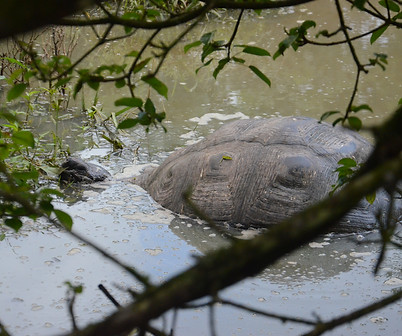
Will sit in warm mud baths to warm up or sit in the shade to cool down (is a reptile and cold-blooded)

Physiological
-
Slow metabolism and large water stores helps them survive for up to a year without food, good for droughts.
-
Gender at birth decided by heat, and since on the equator, produces more egg-laying females.
Archipelago Variation
Santa Cruz Tortoise
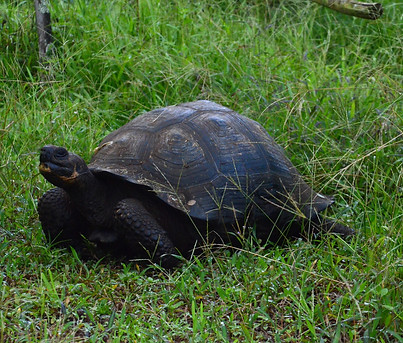
As seen at the El Chato Tortoise Reserve, they have a lower saddle for pushing through undergrowth, and are now a separate species due to lifestyle and shape.

Isabela Tortoise
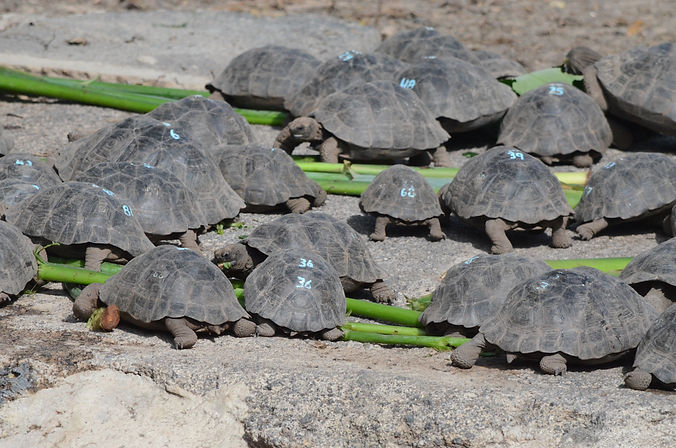
As seen at the Isabela Tortoise Breeding Centre, they have a slightly higher saddle for better neck reach and a slightly different head shape.