Darwin's Finches
Scientific Name: Geospizinae subfamily
Type: Bird (not actually true finches)
Size: 10 - 20 cm (varies wildly across species)
Diet: Varied based on beak (insects, seeds, fruit)
Species Count: 13 endemic to Galapagos
Status: Vulnerable (Differs by island)


Facts
-
From the original finch species, 13 finches are considered part of this family
-
When a group of finches moved to a new island, they, no longer interacted with the species and their mating call changed to a different pattern. Now when they come in contact, due to the isolation and different mating calls, they no longer interbreed
-
The Vampire Finch is a unique finch found on the islands Wolf and Darwin, and has supplemented its usual diet of seeds with the blood of larger birds and animals.
Evolutionary Adaptations
Structural
-
Differing beak shape and length across species for better access to different food sources.
-
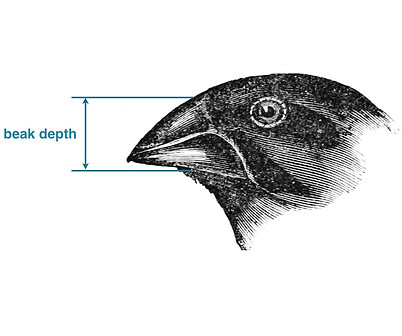
High beak depth and low beak length grants greater crushing power for large seeds
-
Low beak depth and high beak length grants greater control for hunting and eating insects.
-
-
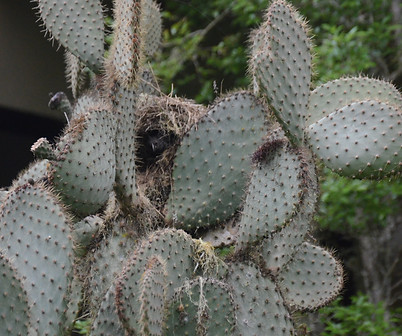
Rounded body shape to more easily fit in small places, such as within the arms of a cactus.

Behavioural
-
Tool use allows access to places the finch wouldn't usually be able to reach, such as grubs inside a tree.
-
Problem solving and teamwork ability to obtain food (such one lifting up a napkin while another grabs food)
-
Choosing to nest in cacti, using their small size to fit inside a place. predators will be unable to reach
-
Different finch species have different mating calls, preventing mixing.
Physiological
-
The presence of bone morphogenetic protein 4 (BMP4) in the developmental stage of the finch embryo, resulting in the variation in beak size (up to 4 cm in a species on average). This protein causes the beak depth to vary wildly, the reason they are considered the fastest adapting bird species in the world.
-
Also related is calmodulin, a calcium protein for bone creation.
-
-
Vampire finch has adapted enzymes to be able to better digest blood.
Archipelago Variation
Ground Finches
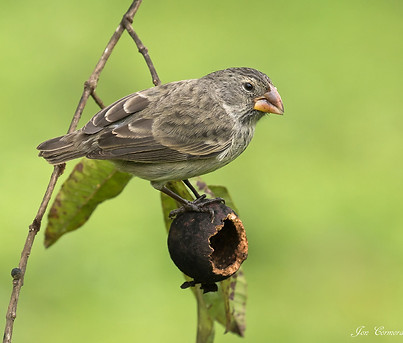
The most common and famous group of finches in the Galapagos, shown in the Grant Finch Study. Feeds primarily on seeds, and forages low vegetation.
Tree Finches
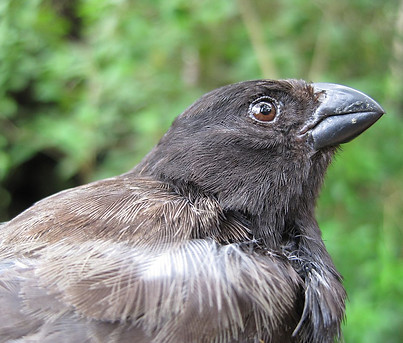
Similar to the ground finches since they are broken into small, medium, and large varieties. Is are found in the highlands, at altitudes in excess of 250 m.

Warbler Finch
These two species of finch were originally considered one species, but after analysis of distribution, song, and appearance, they were separated into Green and Grey.